
Contract Review Automation
Review Every Contract Against Your Standards, Not Just the Ones You Have Time For
Extract clauses, compare each agreement against your playbook, and route deviations to the right reviewer — while the documents stay in the repositories you already use.
The agent recommends; your counsel decides. Every deviation is quoted in full so a human is accepting a specific risk, not a summary of one.
- Fixed scope
- Measurable ROI
- Human-in-the-loop
- Works with your existing stack
Trusted on complex technology delivery
Does any of this look familiar?
These are the symptoms we see before the numbers get measured.
- Standard agreements are reviewed line by line for the same handful of terms
- Low-value contracts skip review entirely because there is no capacity
- Nobody can answer which agreements contain an uncapped liability
- Renewal dates live in someone's calendar rather than a system
- Deviation from the playbook depends on which lawyer picked it up
- Deal desk waits on legal for terms that are actually standard
What this process costs you today
Before anyone talks about technology, it is worth knowing the number you are trying to beat.
A worked example
Modelled estimate2 employees × 9 hours/week of repetitive processing = 936 hours/year.
At $65/hour loaded cost
$60,840
annual process cost
If automation removes
60%
of the manual effort
Recoverable capacity
$36,504
per year
Two reviewers on first-pass contract reading, before counting deals delayed waiting on legal.
Now run it on your own volumes
Your current process
Assumptions
- Fully loaded hourly cost of legal and commercial staff reviewing agreements
- Rework estimated at 1.5x the original review time per missed deviation
- Automatable share of 55–70%, reflecting judgement that stays with counsel
- Payback modelled against a typical single-process implementation investment
Your estimated opportunity
Modelled estimate- Current estimated annual cost
- $191,295≈ 1.8 FTE of manual effort
- Potential automatable effort
- 55–70%
- Indicative payback
- 2 months
- Potential annual opportunity
- $105,212 – $133,907
Directional planning estimate based on your inputs — not a quote or a substitute for finance sign-off.
How we work
- 1
Map
Sit with the people doing the work and document the process as it actually runs — including the workarounds nobody wrote down.
- 2
Measure
Establish a baseline: volume, handling time, error and rework rate, and what the process costs you today.
- 3
Build
Redesign the workflow and build it against your real systems and data — not a mockup or a slide.
- 4
Validate
Test against edge cases, confirm exception handling and approval gates, and measure the result against the baseline.
- 5
Deploy
Move into production with monitoring, runbooks and training — or recommend against it if the numbers do not hold up.
Before and after
Today
- Agreement arrives by email
- Lawyer reads it end to end
- Key terms noted in a spreadsheet
- Deviations discussed by email
- Renewal date added to a calendar
After
- Agreement picked up on arrival
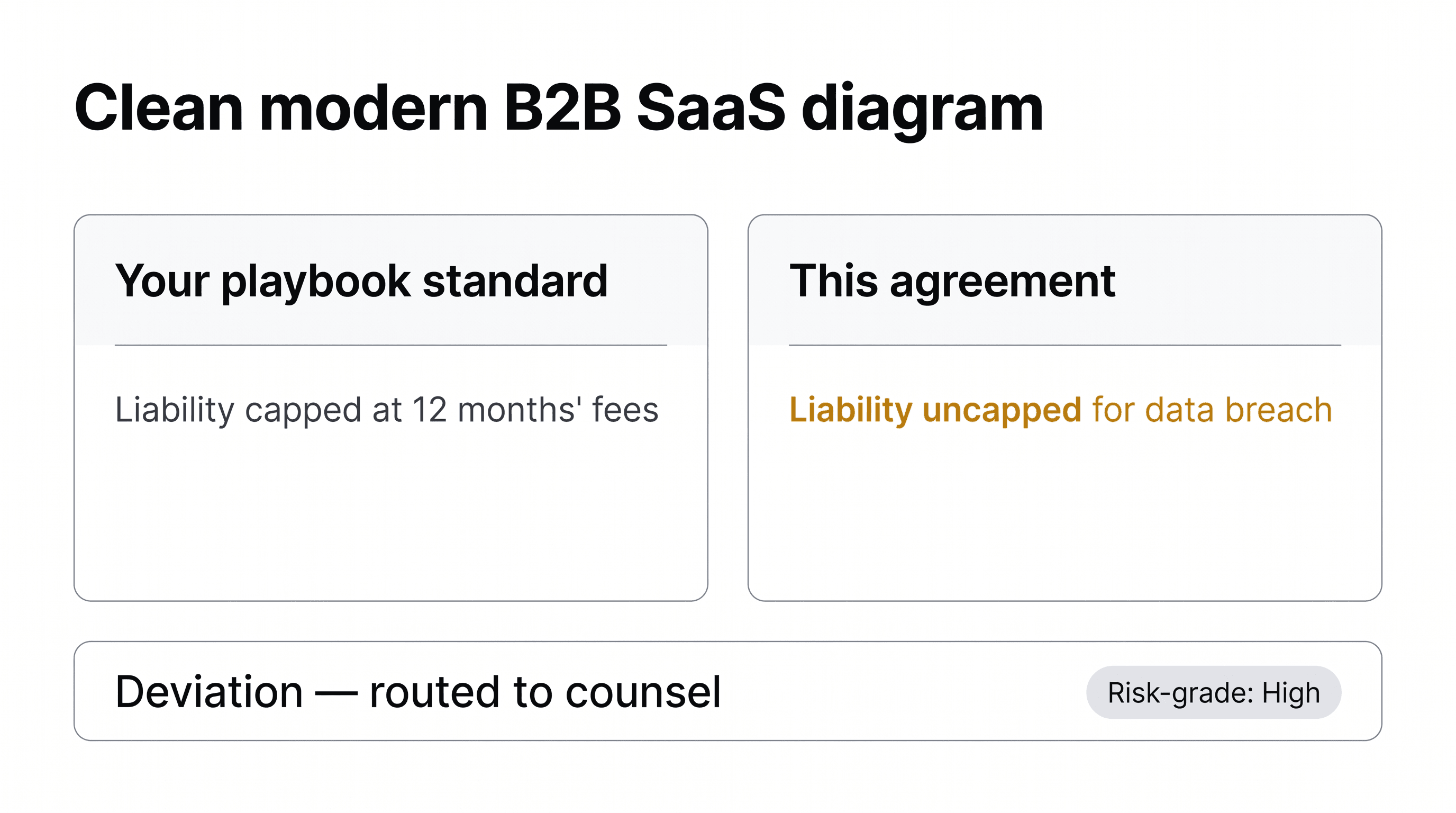
- Clauses extracted and compared to your playbook
- Deviations graded, with the exact language quoted
- Only out-of-policy terms reach counsel
- Obligations and renewal dates written back to your systems
What we automate
- NDA and MSA first-pass review
- Vendor and supplier agreements
- Sales contract deviation checks
- Renewal and obligation tracking
- Liability and indemnity screening
- Data protection clause review
What you receive
- Your playbook encoded as comparable standard positions
- Clause extraction schema for the terms you actually track
- Risk grading against your own thresholds
- Deviation routing to named reviewers with the language quoted
- Obligations and renewal dates written back to your repository
- Accuracy measured on your own agreements before go-live
- Audit trail of what was reviewed and who accepted each risk
What the numbers say
Every figure is labelled by where it comes from — measured customer results, industry benchmarks, modelled estimates, or commitments we make to you.
Evidence
70%
Faster document review
55–70%
Of first-pass review typically automatable
100%
Of agreements checked, not just the ones with capacity
Industry benchmarks are drawn from published automation research and our own delivery baselines. We will share the specific source and assumptions behind any figure here on request — and during the Assessment we replace them with measurements from your own process.
What we commit to
Counsel
Retains sign-off on every risk acceptance
Quoted
Deviations shown in full, never summarised away
Technology we build on
We are not tied to one platform. The right tool depends on the workflow, your existing stack, and what you can maintain.
How we keep it safe
Human approval gates
You decide which decisions an automation may make alone and which require a person. Thresholds are configured to your policy.
Exception handling
Anything ambiguous, incomplete or out of policy routes to a named owner with the reason attached — it does not fail silently.
Audit trail
Every action is logged: what ran, on what input, what it decided, and who approved it. Built for audit and incident review.
Least-privilege access
Automations connect through credentialed, scoped integrations you grant and can revoke. Your systems stay the system of record.
How engagements run
Each stage is a decision point. You only continue if the previous stage justified it.
Process Assessment
Map one process, quantify what it costs today, and get a fixed implementation recommendation.
Fixed fee, credited against a SprintStage 2Automation Sprint
Redesign and build the workflow, then prove whether the economics justify scaling it.
Fixed scope, fixed feeStage 3Production Implementation
Harden a validated workflow for real users, real data, security, monitoring and scale.
Scoped from the Sprint findingsStage 4Managed Automation
Keep automations reliable as systems, rules and volumes change.
Monthly retainerContract Review Automation FAQs
Test contract review on your own agreements
We measure extraction accuracy against contracts you already have, and tell you plainly how much of the first pass is genuinely automatable.