
AI Agent Automation
Give AI Agents a Real Job Inside Your Business
Deploy agents that perform defined business work across your systems, with access controls, audit trails, exception handling and human oversight.
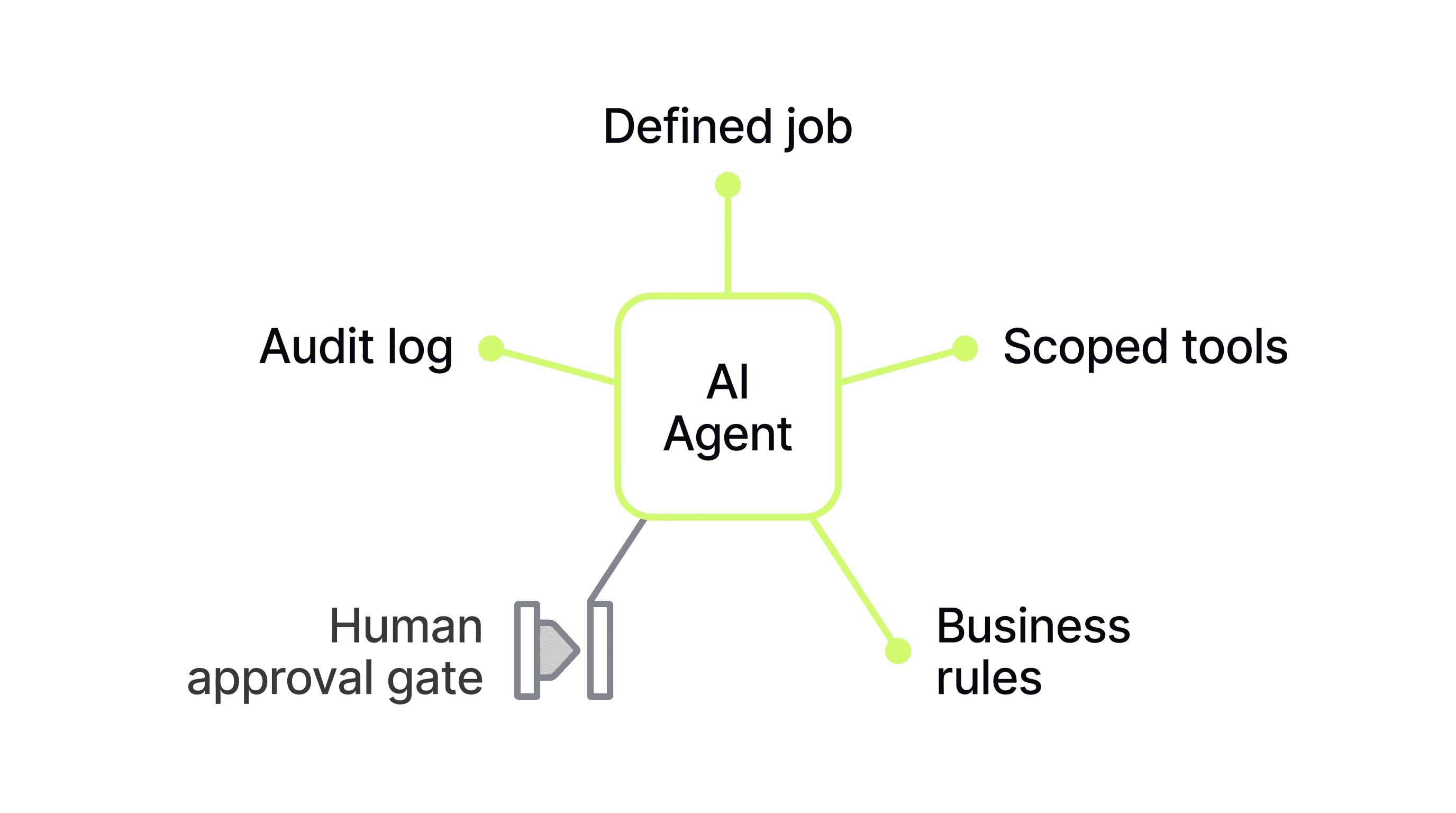
An agent without a defined job, scoped tools and an escalation path is a demo. The engineering is in everything around the model.
- Fixed scope
- Measurable ROI
- Human-in-the-loop
- Works with your existing stack
Trusted on complex technology delivery
Does any of this look familiar?
These are the symptoms we see before the numbers get measured.
- You have seen impressive agent demos and cannot map them onto real work
- A pilot works until it meets a case nobody anticipated
- Nobody can say what the agent is permitted to do, or what happens when it is wrong
- There is no record of why the agent did what it did
- The agent produces output that a person still has to carry somewhere
What this process costs you today
Before anyone talks about technology, it is worth knowing the number you are trying to beat.
A worked example
Modelled estimate3 employees × 8 hours/week of repetitive processing = 1,248 hours/year.
At $55/hour loaded cost
$68,640
annual process cost
If automation removes
60%
of the manual effort
Recoverable capacity
$41,184
per year
Knowledge work where judgement matters but most of the handling is routine.
Now run it on your own volumes
Your current process
Assumptions
- Fully loaded hourly cost of the staff handling these cases today
- Rework estimated at 1.5x the original handling time per failed case
- Automatable share of 50–70%, reflecting judgement steps that stay with people
- Payback modelled against a typical single-process implementation investment
Your estimated opportunity
Modelled estimate- Current estimated annual cost
- $184,646≈ 2.0 FTE of manual effort
- Potential automatable effort
- 50–70%
- Indicative payback
- 2 months
- Potential annual opportunity
- $92,323 – $129,252
Directional planning estimate based on your inputs — not a quote or a substitute for finance sign-off.
How we work
- 1
Map
Sit with the people doing the work and document the process as it actually runs — including the workarounds nobody wrote down.
- 2
Measure
Establish a baseline: volume, handling time, error and rework rate, and what the process costs you today.
- 3
Build
Redesign the workflow and build it against your real systems and data — not a mockup or a slide.
- 4
Validate
Test against edge cases, confirm exception handling and approval gates, and measure the result against the baseline.
- 5
Deploy
Move into production with monitoring, runbooks and training — or recommend against it if the numbers do not hold up.
Before and after
Today
- A prompt and an API key
- Access to whatever the developer's account could reach
- No definition of done
- No path for cases it cannot handle
- No record of its reasoning
After
- A defined job with explicit success criteria
- Scoped tools and least-privilege credentials
- Business rules that constrain what it may decide alone
- An escalation path to a named human
- A full audit trail of inputs, actions and approvals
What we automate
- Document review agent
- Customer operations agent
- Finance exception agent
- Procurement agent
- Research and enrichment agent
- Case management agent
What you receive
The discovery call scopes your needs. Before paid work starts, your proposal confirms the deliverables, acceptance criteria, fee and any ongoing software or support costs. The call does not commit you to a project.
- A defined agent job description — what it does and does not do
- Tool and data access design under least privilege
- Business rules and decision boundaries
- Escalation and human approval points
- Evaluation against your real cases
- Audit logging of every action and decision
- Monitoring and a rollback path
What the numbers say
Every figure is labelled by where it comes from — measured customer results, industry benchmarks, modelled estimates, or commitments we make to you.
Evidence
50–70%
Of case handling typically automatable
Industry benchmarks are drawn from published automation research and our own delivery baselines. We will share the specific source and assumptions behind any figure here on request — and during the Assessment we replace them with measurements from your own process.
What we commit to
Human
Sign-off retained on every judgement call
Audit
Trail on every agent action
Least
Privilege access, revocable at any time
Technology we build on
We are not tied to one platform. The right tool depends on the workflow, your existing stack, and what you can maintain.
How we keep it safe
Human approval gates
You decide which decisions an automation may make alone and which require a person. Thresholds are configured to your policy.
Exception handling
Anything ambiguous, incomplete or out of policy routes to a named owner with the reason attached — it does not fail silently.
Audit trail
Every action is logged: what ran, on what input, what it decided, and who approved it. Built for audit and incident review.
Least-privilege access
Automations connect through credentialed, scoped integrations you grant and can revoke. Your systems stay the system of record.
How engagements run
Each stage is a decision point. You only continue if the previous stage justified it.
Process Assessment
Map one process, quantify what it costs today, and get a fixed implementation recommendation.
Fixed fee, credited against a SprintStage 2Automation Sprint
Redesign and build the workflow, then prove whether the economics justify scaling it.
Fixed scope, fixed feeStage 3Production Implementation
Harden a validated workflow for real users, real data, security, monitoring and scale.
Scoped from the Sprint findingsStage 4Managed Automation
Keep automations reliable as systems, rules and volumes change.
Monthly retainerFAQ
AI Agent Automation FAQs
An automation follows a defined path. An agent decides which path to take within boundaries you set. That flexibility is the point and the risk, which is why the boundaries, escalation and audit trail matter more than the model.
Scoped credentials that only reach the systems and records it needs, business rules that constrain what it may decide alone, approval gates above your thresholds, and a logged trail of every action for review.
It escalates rather than proceeds. Low-confidence and out-of-policy cases route to a named person with the reasoning attached, and every action is reversible and logged.
Next step
Identify an agent-ready workflow
Not every process needs an agent. We will tell you which of yours does, and which is better served by plain rules.