
Industry Insights
Approval is not a prompt
"Security will never approve an agent." They will, when its limits sit outside it. Why a rule in a prompt fails review, and what passes.
Ademola Afolabi
Founder
"Security will never approve an agent."
It is what an operations leader tends to say once a pilot has stalled. The demo went well. The business wants it. Then it went to security review, and it hasn't come back.
The numbers say they are not alone. Only 14.4% of organisations have full security approval for their agents (Gravitee, State of AI Agent Security 2026). And 68% say a security or governance review has delayed, cut back or stopped a project (EMA, Agents Without Guardrails).
It is easy to read that as security teams blocking AI. We read it differently. Often, security is being asked to approve something it cannot test. And the reason is usually where the agent's rules live.
The rule that lives in the prompt
Many AI pilots keep their limits in plain English inside the prompt. "Never refund more than the limit." "Do not change supplier bank details." "Ask a person before approving anything over the threshold."
These lines feel like controls. They read like policy. In a demo, the agent follows them every time.
They are not controls. They are requests.
A prompt is input to the model, in the same channel as everything else the model reads: the customer's email, the invoice text, a document someone uploaded. The model weighs all of it together. Most of the time the rule wins. Sometimes it does not.
Why a reviewer can't sign that off
There are three ordinary ways a prompt rule fails, and none of them needs an attacker.
A bad input. An email or document contains wording that looks like an instruction. The model treats it as one. This is the familiar prompt injection problem, but it also happens by accident.
A long context. The agent has been working through a long case. The rule sits thousands of words back. The model gives it less weight than the material in front of it.
A new model. The vendor ships an update. The prompt is the same, but the model reads it differently. Behaviour tested last month is not the behaviour you have today.
A security reviewer knows all three. So when they ask "what stops this agent issuing a refund over the limit?", and the honest answer is "we told it not to", they cannot approve it. Not because they dislike AI. Because there is nothing to test.
What security can approve
Security can approve a control it can see and test. That means the agent can ask for an action, and something outside the agent decides whether that action is allowed.
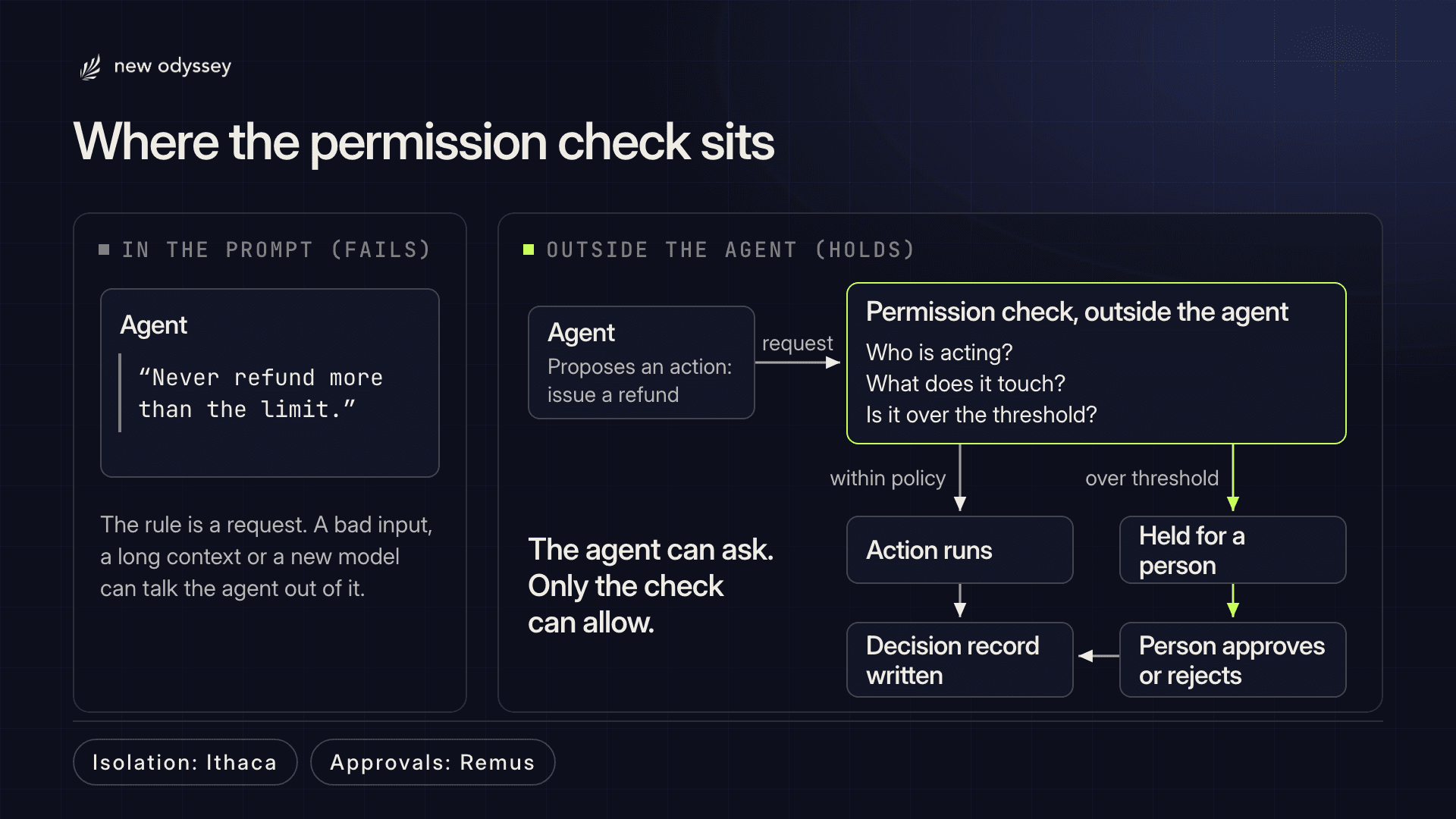
The diagram shows the two set-ups side by side.
On the left, the rule sits in the prompt. The agent reads it, then acts. Nothing between the model and the system checks what it did.
On the right, the agent proposes an action, such as issuing a refund. The request goes to a permission check that runs outside the agent. That check asks three questions: who is acting, what the action touches, and whether it is over the threshold.
If the action is within policy, it runs. If it is over the threshold, it is held for a person, who approves or rejects it. Either way, a decision record is written.
The agent can ask. Only the check can allow.
That is a design a reviewer can test. They can try to push an action through and watch it stop. They can read the policy. They can see every decision it held.
Two parts: isolation and approval
In our stack, this takes two pieces working together.
The first is isolation. The agent runs in a space where it can only reach what it has been given. It holds no standing credentials to the ledger or the claims system. Every action goes through a controlled route. Without isolation, a permission check is only advice, because the agent could go around it. This is Ithaca.
The second is approval. Some actions are fine to automate. Some need a person. The threshold is set by the business, held outside the agent, and changed through a controlled process, not by editing a prompt. When an action crosses the line, it waits. A named person sees the evidence and decides. The decision is recorded. This is Remus.
Neither piece makes the agent smarter. Both make it governable, and governable is what security signs.
How the review conversation changes
With permissions outside the agent, the answers a reviewer hears are different.
Instead of "we told the model not to", it is "the agent has no route to do that". Instead of "we tested it and it behaved", it is "here is the policy, here is where it is enforced, and here is every decision it held".
A threshold can change without re-prompting anything. Finance can lower a refund limit on a Friday afternoon and know it applies to the next request.
And when the model is updated, the controls do not move. The model can read the prompt however it likes. The check does not care.
What we look at
When we review a stalled pilot, this is one of the first things we examine. We map every action the agent can take that changes something: a payment, a refund, a record update, a message to a customer. For each, we find where the limit lives today and what the agent's credentials could reach if it ignored it.
The client gets that map in writing, with each gap ranked and a named owner on each fix. It is also the evidence a security team asks for, so the review often answers the question that stalled the pilot in the first place.
Stuck at security review? Our pilot-to-production review shows what's running, what it can touch, and the path to production. Fixed fee, agreed on a 20-minute call.
Assess my workflowPublished
November 19, 2026
Last updated
November 19, 2026
Author
Ademola Afolabi · Founder
Reviewer
New Odyssey Editorial Team · Editorial Review
Methodology
This industry insights piece is maintained by the New Odyssey editorial and delivery teams using current implementation patterns and operating assumptions.
Which of your workflows is worth automating?
Answer three questions about the process you want to automate and see what it costs you today.
Assess my workflowStay updated
Get weekly integration insights delivered to your inbox.