
Industry Insights
Decision history
"Our auditor already covers this." An audit tests your controls. It doesn't record who approved each AI decision, and on what evidence. An examiner asks for that.
Ademola Afolabi
Founder
"Our auditor already covers this."
It is a reasonable thing for a CFO or a head of internal audit to say. The bank or credit union has an external audit. It has internal audit. Controls are tested every year. Why would AI need anything more?
Because an audit and an examiner are asking different questions.
An audit tests whether your controls are designed well and working. It samples. It asks whether a control exists and whether it operated over the period.
An examiner looking at AI asks something narrower and harder. For a decision that mattered: which AI was involved, which rule applied, who approved it, when, and on what evidence? That is not a test of a control. It is a request for a record. If the record was never written, no audit can produce it afterwards.
What examiners can ask for
The guidance is clear about the direction. The NAIC model bulletin expects insurers to keep a written AI programme, a model inventory and due diligence on third-party vendors, covering audit rights, validation and drift testing. Regulators can ask for all of it in an exam. The NCUA expects credit unions that use a vendor's AI to understand how it works, what risks it adds and what controls the vendor has.
Few firms say they are ready. Only 23% of financial services firms have mature governance for autonomous agents (Deloitte). Only 42% of IT and security teams have a standard process for assessing third-party AI risk (Drata).
The gap is not usually policy. Most firms have a policy, and an auditor can confirm it. The gap is evidence: a record, for each decision, that shows the policy was followed.
Logs are not decision history
Most AI systems log activity. They record that a request came in, that a model was called, that an action happened. That is useful for engineers, and it is often what an auditor samples. It is not what an examiner needs.
A log tells you what happened. Decision history tells you why it was allowed to happen.
The difference shows up the moment you are asked about one case. "Why was this refund paid?" A log can show the payment. It usually cannot show which rule applied, whether a person was involved, who that person was, or what they were looking at when they agreed.
When an agent acts on its own, and a person approves some of its actions, you need both halves joined: the agent's request and the human decision, in one record.
What one decision record holds
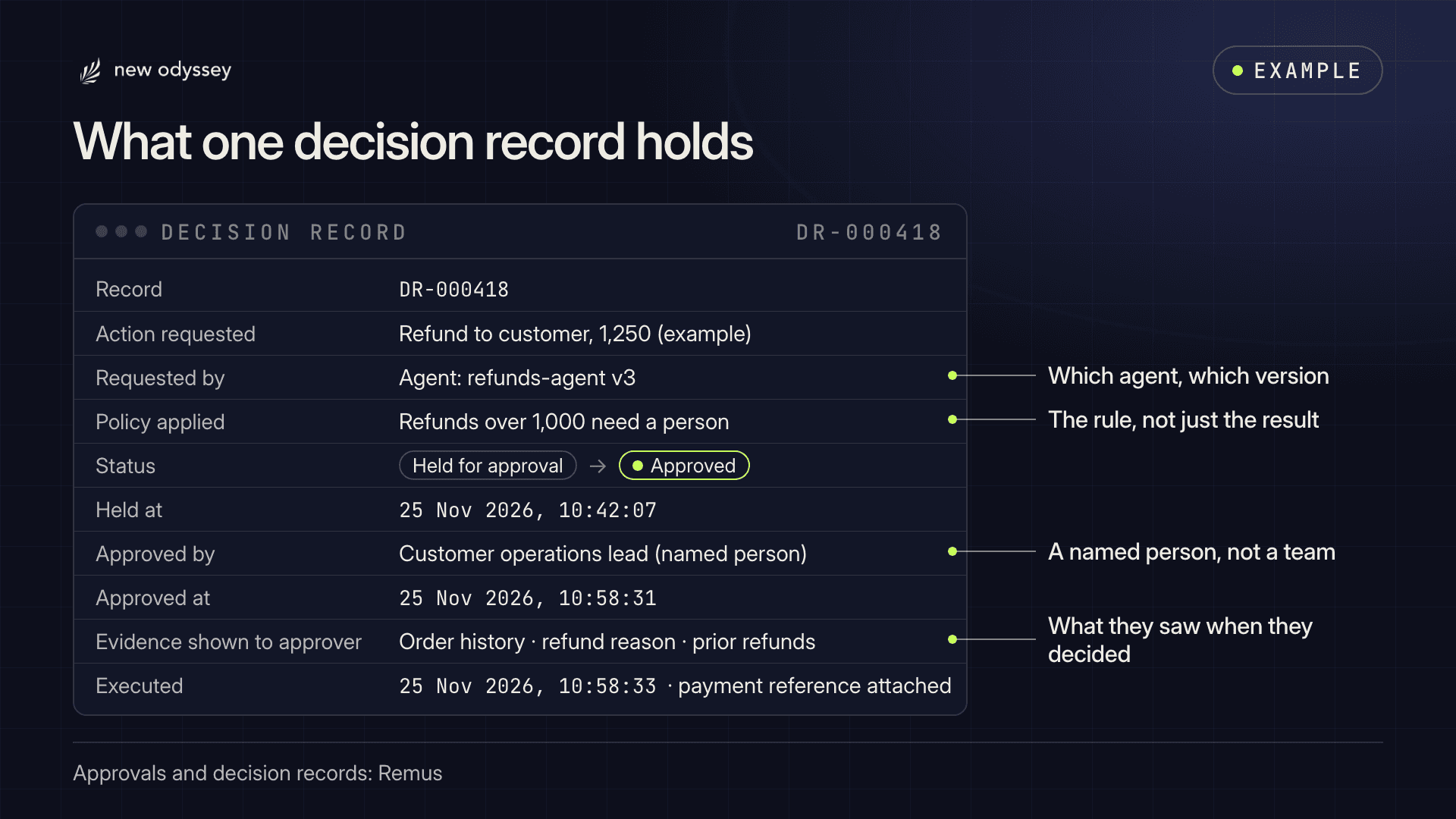
The diagram shows one example record. The figures and timings in it are invented for illustration. Each field answers a question an examiner can ask.
- Record: a unique reference, here DR-000418, so the decision can be found and cited.
- Action requested: what the agent wanted to do. In the example, a refund to a customer of 1,250.
- Requested by: which agent, and which version. "Agent: refunds-agent v3." If the agent changes, you need to know which version made which request.
- Policy applied: the rule, not just the outcome. "Refunds over 1,000 need a person." This proves the decision was tested against a written limit.
- Status: held for approval, then approved. The record shows the hold happened, not only the result.
- Held at: the time the action was stopped.
- Approved by: a named person, in this case the customer operations lead. Not "the operations team". A named person can be asked about it.
- Approved at: the time they decided. The gap between held and approved shows the check was real.
- Evidence shown to approver: what they saw when they decided. Order history, the refund reason, prior refunds. This is the field most systems leave out, and the one that matters most when a decision is challenged.
- Executed: when the action ran, with the payment reference attached, so the record links to the ledger.
Ten fields. None of them is hard to capture at the moment the decision is made. Almost all of them are hard to rebuild six months later from logs and email, and that is exactly the work an audit can't do for you.
Written at the time, by the thing that decides
We build these records to be written by the system that enforces the decision, at the moment it enforces it.
If approvals happen in email or chat and the agent's actions are logged somewhere else, someone has to join them later. That join is where errors and gaps appear. It is also slow, and exams have deadlines.
When the approval check sits outside the agent, it is in the right place to write the record. It sees the request, applies the policy, holds the action, captures who approved it and what they saw, and records the result. In our stack, this is Remus: it holds any action over a threshold until a person approves, and keeps the decision record.
Your auditor can then test something real. The control exists, it operated, and here is every decision it touched.
Vendor AI needs the same history
Much of the AI in a bank or insurer is not built in-house. It sits inside a vendor's product: a fraud tool, a lending platform, a claims system.
The same question applies. If the vendor's AI recommends or takes an action, can you show the record? Can you export it? Can an examiner read it without the vendor in the room? An audit of your own controls won't answer that either.
Our week 2 carousel lists twelve questions to put to a vendor before you sign, written for credit unions and community banks.
What we look at
In an AI vendor and agent controls review, we look at each AI system in use, in-house or vendor, and ask what an examiner would ask: who owns it, what it can change without a person, and whether a decision record exists for what it did. We check how approval thresholds are set and changed, and whether each approval names a person and the evidence they saw.
The client gets workpapers an examiner can follow, a board readout, and a 30/60/90-day plan with a named owner on each action. It sits alongside the audit. It doesn't replace it.
Need workpapers an examiner will accept? Our AI vendor and agent controls review checks your vendors and agents, and ends with a board readout. Fixed fee, agreed on a 20-minute call.
Assess my workflowPublished
November 25, 2026
Last updated
November 25, 2026
Author
Ademola Afolabi · Founder
Reviewer
New Odyssey Editorial Team · Editorial Review
Methodology
This industry insights piece is maintained by the New Odyssey editorial and delivery teams using current implementation patterns and operating assumptions.
Which of your workflows is worth automating?
Answer three questions about the process you want to automate and see what it costs you today.
Assess my workflowStay updated
Get weekly integration insights delivered to your inbox.